What Causes Acne
Common causes of acne and their treatment solutions |
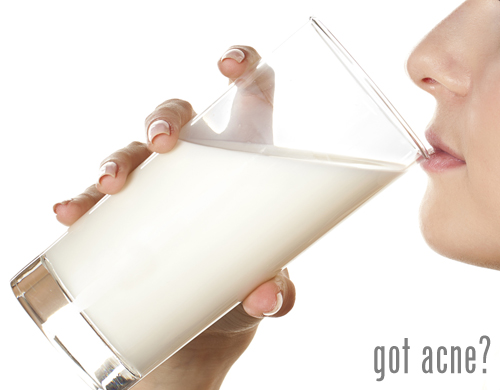
Dairy can trigger acne for some people
Figuring out why you get acne is one of the best things you can do for successful acne treatment. If you know what is breaking you out, you will then know how to make the breakouts stop. It's not easy to figure out and once your skin clears, the exact reason behind all the pimples may still be unknown. However, understanding the common triggers of acne will help you narrow down the search for a clear skin solution.
If you can kind of guess what's causing your skin problems, you stand a better chance of fixing them. For example, let's say you thought bacteria was causing your breakouts so you started using an antibiotic. But that didn't work, so then you tried not drinking milk, thinking your acne may be related to a food allergy, etc. One by one, as you go through all the potential causes of acne, you will eventually figure out what is making your skin break out, so you can reverse engineer a regimen that will prevent acne and keep your skin clear.
Knowing what causes acne will provide a checklist of things to go through as you experiment with different acne treatment products. Armed with this information, it will hopefully make the process of clearing your skin somewhat less confusing and frustrating - because we all know how frustrating and depressing acne can be!
Since there are so many things that can cause or aggravate acne, the below chart consolidates all the information in one place to help you simplify your acne research. It lists some of the most common causes of acne, acne triggers and aggravators, their descriptions and symptoms, along with potential acne treatment options for each acne cause. Use this below chart as starting point to figure out what may be causing your breakouts!
NOTE: If you are feeling overwhelmed with everything and just don't know where or how to start anymore, please take a minute to read this acne guide.
13 Common Causes of Acne
| Acne Culprits | Description | Acne Treatment Options |
|---|---|---|
| 1. Genetics | Genes play a big role in the make up of your skin. Take a look at your parents' skin or ask them about their skin history and that should give you an idea of your own skin issues. Some people are just blessed with beautiful skin genes and can sleep in a tub of lard everyday without getting a single pimple. Others, like me, are not as blessed. My dad has bad breakouts and huge pores, but my mom has porcelain skin. The only thing she uses is Vaseline, believe it or not. And who do I take after? My dad, of course. Life is sometimes just not fair! |
There's nothing you can do about your genetic makeup. However, if your parents have decent skin now, then you likely won't be cursed with acne for life. In fact, if your parents had skin issues, whatever they did to treat them might work for you. Of course, do your own follow-up research because acne products and acne treatments have evolved as information and technology have improved. Acne is also very individual and will require a customized approach to each person's skin. While you can't change the genes you inherited, having a good skin care routine and looking into different acne treatments will definitely help. It's more nurture than nature in this case. |
| 2. Hormones | The most obvious examples of hormonal acne is the acne you get during puberty, menstrual cycles, pregnancy, and menopause. Hormonal acne, especially adult acne, tends to occur lower on the face, around the chin and jaw line. Hormonal pimples also tend to occur with no obvious explanation and be bigger and deeper spots. Women typically experience more adult hormonal acne than men because of their monthly periods. However, men may also experience hormonal acne. Spikes in testosterone are the likely cause and this can be triggered by eating too much soy, protein bars, etc. In my experience, hormonal acne is also the kind of acne that hurts and shows up randomly with no apparent reason. So, if you get lots of deep pimples and/or cysts, there's a good chance those are related to your hormones. |
Keep a diary of your pimples and see if they pop up around the same time every month. Tracking your acne and taking detailed notes of when they occur during your cycle (if you are female) will help you get a better understanding of how your skin works.
If you consistently break out at a certain time each month, your acne may be related to your hormones. You can also get your hormone levels checked to see if they are normal. Though if you do have hormonal imbalances, they would probably manifest themselves in other aspects of your health. Be aware that some hormonal sensitivities are too small to show up on medical tests. Topical treatments can only do so much for hormonal acne, but they can help mitigate the situation by helping your skin turn over at the proper rate. Supplements, oral contraceptives, and spironolactone are other alternatives. Some people find that fish oil or omega-3s help regulate hormones, as well as drinking spearmint tea. Whatever the case, how you respond to certain treatments is largely individual, so you must research each treatment thoroughly. Keep in mind that usually there is no way to tell if something will work for you or not without trying it out for yourself. |
| 3. Bacteria | P. acnes, the acne bacteria, gets a pretty bad rep. People assume that you kill the bacteria and you kill the acne. However, p. acnes exists on everyone's skin, whether it's clear or riddled with pimples.
P. acnes feeds off sebum. With acne-prone skin, there is usually an overproduction of sebum or sebum doesn't get sloughed off properly and gets trapped in hair follicles, either way creating fertile grounds for p. acnes growth. You can kill off p. acnes, but it will keep coming back as long as it can make a home in your skin. Destroy the home and destroy the bacteria. |
Topical or oral antibiotics kill bacteria. I don't like taking oral antibiotics for acne because they obliterate all the bacteria in your system, both good and bad. However, people respond differently to different treatments. Antibiotics may work initially, but they may not be a long-term solution for clear skin, as some people eventually develop bacterial resistance to the treatment. Antibiotics are commonly prescribed with a retinoid to reduce purging and jump start the skin clearing process. Antibiotics are, in my opinion, a sidekick product because you can kill off bacteria, but you still have to keep your skin healthy so p. acnes can't settle down in its home and cause you to break out. Other topicals, such as benzoyl peroxide and tea tree oil, also help to kill surface bacteria. |
| 4. Cosmetically Related Acne | This is the kind of acne you get when you use a new product and start to break out. It could be from makeup, sunscreen, products with ingredients that clog your pores, irritating fragrance from fabric softeners, or even irritation from toothpaste. It could also be hygiene related, such as improperly removing makeup and/or sunscreen, not cleaning cell phones, not changing pillow cases often, or using dirty makeup brushes. |
These breakouts usually subside once you stop using the particular product, but it may take a few weeks for your skin to return to its previous state. To treat these kinds of breakouts, practice proper hygiene: Thoroughly (but gently) clean your skin, remove waterproof makeup and sunscreen before bed (these usually require an oil-based cleanser to completely remove), use allergen-free detergents and fabric softeners, clean cell phones, change pillow cases, etc. Introduce new products to your skin care routine one at a time so you can tell which products are breaking you out. When you use more than one new product at the same time, you don't have as good an idea of which product is doing what. The best thing to do (if you have the patience for it) is to patch test all new products on a small part of your face for at least a week to see if there are any adverse reactions. Look at product ingredient lists to see which ingredients are potentially irritating and steer clear of pore clogging ingredients. Products labeled "non-comedogenic" are generally safe, but everything depends on how your skin reacts, so it's best to research ingredients lists of those products too. To give you an example, my skin is clog-prone and gets super clogged up if I use anything with coconut derivatives in them, but other acne-prone people can use these ingredients on their skin just fine. |
| 5. Food Allergies or Sensitivities | Food allergies are very subtle but they can pack a big punch in the acne department. These include a sensitivity to milk, dairy, iodine, gluten, biotin, sugar, soy, etc.
If you have acne from food sensitivities, the pimples might take 4-5 days to show up after eating a particular food. For example, if you eat shrimp one day and break out the next, that is generally too short of a time span to tell if the shrimp was the actual acne culprit, unless you had an immediate allergic reaction. |
Keep a daily food journal and track when you get breakouts. You can isolate milk, iodine-rich foods (seafood, iodized salt), or whatever food sensitivity of your choice from your diet one at a time to see if your skin gets better. To do this, cut out a certain food from your diet for 2-3 months. Track how your skin has changed during this time. Then, introduce the food back to your diet and track your skin for an additional 1-2 months to see what impact that particular food has on your acne. Otherwise, you can get an allergy test to see if you are allergic to anything. Slight food sensitivities, however, may not show up in allergy test panels. Note: Some people also see their skin get better after switching to organic milk because of fewer hormones in the milk. |
| 6. Poor Cell Turnover Rate | This is when dead skin cells are not being shed at the proper rate and contribute to pore blockage, which then leads to acne. | Manual and/or chemical exfoliants (AHAs, BHAs, retinoids) can help your skin shed more properly. However, there is a fine line between exfoliating your skin and overdoing it. It's very easy to cross that line, so when you exfoliate, you want to do it gently. It will also take some experimenting for you to find the perfect amount of exfoliation that works for you. If anything, start slow. Exfoliate once a week in the very beginning. After a week of doing that, bump it up to exfoliating twice a week. Slowly increase (or decrease) the amount you exfoliate depending on how your skin reacts. Some people can exfoliate everyday with no problems whatsoever, while for others, exfoliating everyday will give them red and raw skin. Really pay attention to your skin and listen to what it's trying to tell you. |
| 7. Disturbed Skin Barrier Function | When your skin is irritated (red, flaky, itchy, stingy) or overly dry, it can make you more vulnerable to p.acnes.
With poor skin barrier function, your skin doesn't do a good job protecting itself and keeping itself healthy. This is one of the reasons why people with dry skin can get acne, when acne is usually associated with oily skin. This is also why some people see their skin improve after using "nothing" for awhile. Often when you use too many products and do too much to your skin, you can self-induce acne from irritation. This includes over-using acne treatments, over-exfoliating, and picking and squeezing at spots. |
Use gentle products (particularly cleansers) instead of harsh ones so you don't wash or strip away your skin's natural moisture.
Don't use harsh scrubs either, because you could be giving your skin microscopic tears! If you do exfoliate, gentle is the key. Part of the reason why some people see their skin clear up after using "nothing" or "water only" is because their skin finally gets a break and a chance to recover. Look at your skin and listen to what it's telling you. Even though most acne treatments instruct you to apply the product twice a day everyday, you shouldn't do that if your skin is sensitive or irritated. It is okay to use a treatment once every other day or even once every 3 days. Customize all treatment applications to your specific type of skin. Don't be too aggressive! And finally, don't touch your face. The more you mess with your acne and pick and squeeze, the more acne you will get later on. I learned this the hard way. |
| 8. Underlying Health Problems | Underlying health problems can also cause acne. These include candida, thyroid problems, PCOS, diabetes, digestive imbalances, and metabolism issues. |
While the presence of acne isn't enough to make a diagnosis for any illness, acne can be a symptom of underlying health problems.
The only way to know for sure is to get a medical check up. Consult your doctor if you are experiencing other health related symptoms. |
| 9. Stress, Lack of Sleep | Stress can wreak havoc on skin and worsen acne symptoms. But it isn't so direct a cause of acne that every time you feel stressed, you instantly get a new pimple. The alternative, being stress-free, also doesn't guarantee clear skin. Stress, however, is definitely something that can aggravate acne and make it worse. Sleep is also very important, not only for your skin, but also so your body can repair itself as you rest. Similar to stress, sleep may not directly cause acne (and sleeping more may not clear your skin), but a lack of sleep can contribute to more breakouts. |
Too much stress and too little sleep create less than ideal conditions for having clear skin. While having less stress and more sleep will not guarantee less acne, less stress and more sleep will give you a better skin foundation so you stand a better chance of preventing breakouts. While it's close to impossible to be stress-free, try not to stress out too much. Breathe deeply, meditate, exercise, think happy thoughts, take regular breaks, have a dance party, or simply count to ten! Also, try to keep a normal sleeping schedule so your circadian rhythms don't get out of whack. My Chinese medicine doctor always says to sleep early (10pm) and wake early (6am). |
| 10. Overly Active Sebaceous Glands | This is usually what happens during puberty, when hormonal changes cause oil glands to change, producing more oil, and creating a fertile environment for p. acnes. | Topical acne treatments can help, but it may take some experimenting before you find the treatment that works. For super oily skin, benzoyl peroxide or sulfur (more drying acne treatments) may be a good place to start. Using oil blotters throughout the day so excess oil won’t be sitting on the surface of your skin is another option. However, your skin does need some oils to function properly! As a last resort, Accutane can help eliminate oil production, but it is a very serious drug, so proper research and consideration must be taken before going on it. Finally, your skin changes as you age, so as you get older, you might find your skin get less and less oily. This may lead to you "growing out" of acne. |
| 11. Diet | While Western dermatologists don't think there is a connection between diet and acne, most Asian dermatologists are more willing to make this link.
Too much sugar, alcohol, caffeine, etc. can aggravate acne. Meat, dairy, and soy also contain hormones that you may be sensitive to. This goes back to food allergies (number 5 on this chart) as a potential cause of acne. My dermatologist in Taiwan actually advises his patients to eat less sugar, drink less coffee, and avoid alcohol, peanuts, and eggplants. |
You could try switching to an organic diet to see if your skin improves.
Or you can try eliminating certain foods from your diet, but eliminating them doesn't necessarily mean you will clear your skin. I find that when I eat less processed foods, my skin looks calmer. I don't break out if I eat french fries or chocolate, but when I eat a lot of junk food, I feel like my skin looks a bit more haggard. Too many sweets and refined sugar does the same thing, making my skin look rough. Diet helps your overall skin condition, but unless your acne is from a food allergy, you will probably need another type of acne treatment (topical or internal) to bolster your treatment. |
| 12. Toxin Build-Up | Toxins can build up in your body through constipation or poor liver/kidney/intestinal function.
When this happens, the build up gets released through your skin, resulting in acne. Some people think sweat can cause acne, but in my experience (and I sweat a lot), sweat is a good thing for your skin. Toxins aren't sweat out either. |
Many people believe that when your body isn't getting rid of toxins properly, the toxins will show up as acne on your skin. I tend to think that your body cleanses itself (internally) just fine, but to each his own.
Possible treatment options for toxin-induced acne include internal cleanses (not to be taken lightly; these can be very dangerous without professional medical guidance) or dietary changes. Eating cleaner and getting enough exercise will probably make the biggest difference. |
| 13. Mixed Signals | A lot of times, acne lesions can be mistaken for Rosacea flares, different types of dermatitis, and/or keratosis pilaris. | A qualified dermatologist will be able to give you an accurate diagnosis. However, it's probably best to get at least 2 opinions because a lot of these skin conditions look quite similar and can easily be mistaken for one another. |
When isolating the potential causes of your acne, you have to treat the process like a science experiment. Keep track of everything: what you put on your skin, what you eat, how you're feeling, where you get your acne on your face, when you break out, whether pimples hurt, how big they are, etc. And keep track of everything for a good 2-3 months so you can get a better understanding of how your skin works, how it reacts, and what it likes or doesn't like.
Knowledge is the first step to learning how to clear your skin and without understanding what causes acne for you individually, you will forever be treating the symptoms of acne and not the cause. Treating the symptoms is pointless if acne is always going to come back. The only way to clear your skin is to prevent acne by stopping what's causing it.
Aside from gathering useful information about acne, a healthy dose of patience and perseverance will help tremendously on the journey to clear skin! The process can be frustrating, but the more you learn about your skin, the better you will be when it comes to getting rid of acne.
If you tend to break out only in certain areas of your face, check out this interactive acne face map. It illustrates what it means when you get acne on your forehead, temples, nose, cheeks, around the mouth, or chin and what you can do about it.
Last updated: May 1, 2013
Related articles:
- Body Acne Map: What is your body trying to tell you?
- DIY: Homemade TendSkin
- Facial Procedures: TCA Peels for Skin and Acne
- Product Recommendations: Acne Treatments
- FAQ: Is it okay to use BHAs or AHAs with retinoids?
- How to Properly Extract a Pimple
